
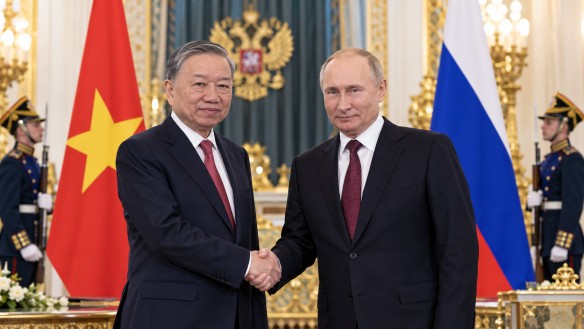
In a display of diplomatic tradition, Russian President Vladimir Putin welcomed Vietnam’s General Secretary and President Tô Lâm and his spouse, Ngô Phương Ly, with an official ceremony at the Kremlin in Moscow. This event marked a significant moment in Tô Lâm’s state visit to Russia, which underscores the ongoing relationship between the two nations. Held at the prestigious St George’s Hall within the Grand Kremlin Palace, the ceremony began with an exchange of pleasantries between the two leaders, followed by the playing of their national anthems. Delegates from both countries were also introduced during this formal gathering.
Subsequent to the ceremony, Tô Lâm and Putin engaged in discussions and oversaw the signing of various bilateral cooperation documents. Afterwards, they addressed the media, reflecting on the significance of their meetings. The relationship between Vietnam and Russia has a rich history that spans over 75 years, built on a foundation of trust and mutual respect. This longstanding friendship is often reinforced through high-level exchanges and collaboration in multilateral organizations and international forums.
The scope of cooperation between Vietnam and Russia extends beyond politics, encompassing cultural, scientific, and technological exchanges. These areas have become increasingly integral to their comprehensive strategic partnership, with scientific and technological collaboration emerging as a promising new focus. Furthermore, the Vietnamese community residing in Russia plays a crucial role in fostering and enhancing the ties between the two nations.
Tô Lâm’s visit to Russia serves as a reaffirmation of Vietnam’s dedication to maintaining its traditional friendship and strategic partnership with Russia. It also aligns with Vietnam’s foreign policy objectives of independence, self-reliance, and diversification of international relations. During the visit, both countries are expected to delve into potential areas of further cooperation such as energy, technology, human-resource development, and infrastructure. These discussions aim to identify strategic priorities and strengthen bilateral relations in accordance with the development aspirations of both nations.