
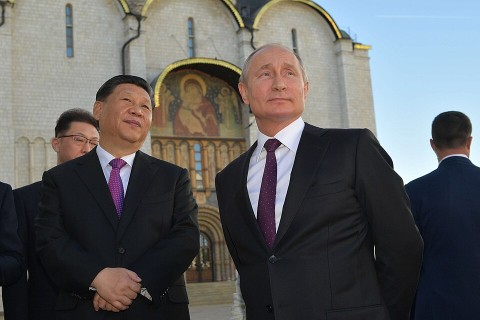
In a series of diplomatic exchanges, Chinese President Xi Jinping and Russian President Vladimir Putin sent each other “congratulatory letters” on Sunday, just ahead of Putin’s scheduled visit to Beijing. This visit comes shortly after former U.S. President Donald Trump’s departure from China following a crucial summit. Xi highlighted the strengthening and deepening of Russia-China collaboration, noting the 30th anniversary of their strategic partnership this year, according to reports from Chinese state media.
Putin’s visit is set to commence on Tuesday evening, with a meeting with Xi planned for Wednesday morning, as detailed by Yuri Ushakov, an aide from the Kremlin. The discussions between the two leaders are expected to cover various facets of their bilateral relationship, including the proposed Power of Siberia 2 gas pipeline. The close scheduling of visits from the leaders of both Russia and the United States has drawn significant attention, with experts pointing out that such a sequence of visits is a rare occurrence in the post-cold war era.
The deepening ties between China and Russia have increasingly worried Western nations, especially in light of Russia’s comprehensive invasion of Ukraine in 2022. China’s economic and diplomatic backing of Russia has been instrumental in sustaining the conflict, according to Western diplomats and analysts. Since the onset of the war, China and Russia have seen unprecedented levels in bilateral trade, with China purchasing over a quarter of Russia’s exports. The large-scale procurement of Russian crude oil by China has provided Moscow with substantial revenue, measured in hundreds of billions, to finance the conflict in Ukraine.
Since the beginning of the Ukraine conflict, China has spent more than $367 billion on Russian fossil fuels, according to the Centre for Research on Energy and Clean Air. These acquisitions have bolstered China’s energy security, especially crucial given the recent disruptions in the Middle East that have impacted oil shipments through the Strait of Hormuz. Notably, the Ukraine war and China-Russia relations were not prominent topics in Trump’s recent discussions with Xi. Instead, their talks primarily centered on trade, Taiwan, and the Middle East, with Trump remarking that China shared his urgency regarding the reopening of the Strait of Hormuz.
During these talks, Xi cautioned Trump on the sensitive issue of Taiwan, emphasizing the potential for conflict if not handled appropriately. Trump left China undecided on a significant arms deal to Taiwan, which, if halted, would be a considerable victory for Beijing, given its ambitions over the self-governing island—a prospect opposed by most Taiwanese. Joseph Webster of the Atlantic Council has suggested that Taiwan might be a key underlying theme in the Xi-Putin meeting. He noted that Beijing could be pursuing more fossil fuel agreements with Moscow to secure its energy supply in the event of a Taiwan conflict. The proposed expansion of Russian oil pipeline capacity to China, specifically through the Power of Siberia 2, could significantly fortify Beijing’s energy security in such a scenario.