
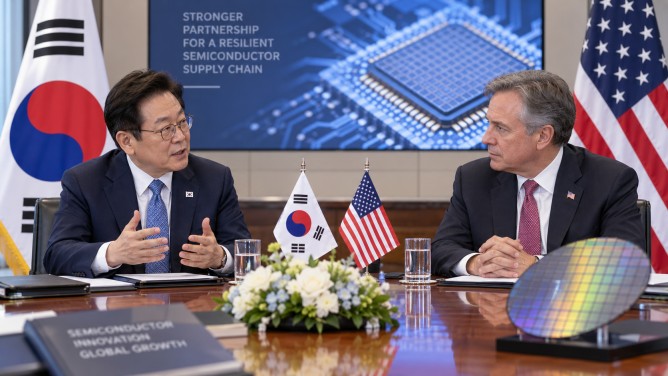
As South Korea and the United States engage in negotiations, a key focus has emerged around semiconductor investments on American soil, according to a South Korean presidential official. These discussions are occurring amidst Washington’s contemplation of new tariffs that could impact semiconductor imports. U.S. authorities have warned that businesses might incur increased expenses if they do not bolster semiconductor manufacturing within the country.
In a significant move last year, South Korea pledged to invest $350 billion in U.S. manufacturing, a commitment aimed at strengthening bilateral economic ties. As part of this investment framework, it was agreed that South Korean chipmakers, such as Samsung Electronics and SK Hynix, would enjoy tariff rates comparable to those afforded to other key semiconductor trading partners. Both companies are major players in the memory-chip industry, and there is a growing demand for their products as technological firms enhance investments in artificial intelligence infrastructure.
The discussions between the two nations come at a time when the semiconductor industry is under intense scrutiny, with the U.S. government emphasizing the need to increase domestic production to ensure a stable supply chain. This strategic approach by the U.S. seeks to mitigate reliance on foreign chipmakers and fortify national security, given the critical role semiconductors play in modern technology.
In addition to economic discussions, South Korea and the United States are also engaged in talks concerning national security matters. However, progress appears to be slow, especially regarding Seoul’s ambitions to develop a nuclear-powered submarine. Despite the limited headway in this area, the ongoing dialogues reflect a broad spectrum of issues that the two nations are navigating in their diplomatic engagements.