
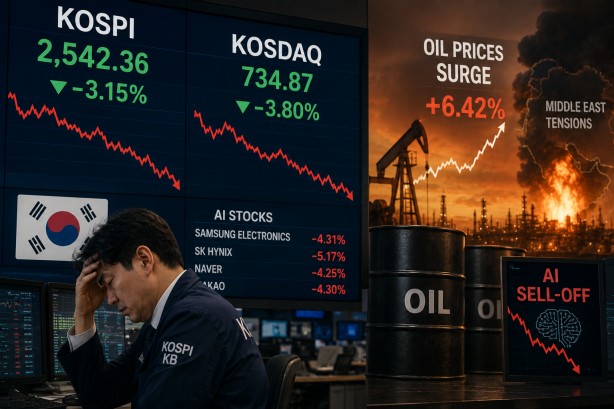
Asian markets displayed a mostly positive trend on Monday despite significant declines in South Korea’s Kospi index, which plummeted nearly 5%. This downturn was driven by investors offloading shares in companies linked to artificial intelligence, amid mounting worries about the valuations within this sector.
Oil prices saw a sharp increase, with Brent crude rising by 2.6% to reach $90.40 per barrel, while U.S. crude climbed 2.2% to $83.58 per barrel. The surge in prices was attributed to escalating tensions between the United States and Iran, which have heightened concerns about potential disruptions in the Middle East. In particular, apprehensions over global oil supplies were exacerbated by a noticeable slowdown in tanker traffic through the Strait of Hormuz, a crucial passageway for energy exports.
The decline in South Korea’s Kospi index, which fell by 4.9%, was largely due to significant losses in the technology sector. Samsung Electronics experienced a 4.4% drop, and chipmaker SK Hynix saw a decline of 3.3%. In contrast, Taiwan’s stock market remained relatively stable, with Taiwan Semiconductor Manufacturing Co. seeing a modest gain of 2%. Other markets in the region showed positive movements, with Hong Kong’s Hang Seng index rising by 2.1% and China’s Shanghai Composite increasing by 1.2%. Australia’s benchmark index also saw slight gains, while India’s Sensex fell by 0.9%.
Globally, technology stocks have been under scrutiny, as investors reassess whether the substantial investments in artificial intelligence have led to a market bubble. This sentiment was further affected by the introduction of Kimi K3, a new open-source AI model developed by the Beijing-based company Moonshot AI, which has intensified competition in the rapidly evolving sector.
In the United States, Wall Street concluded the previous week with losses across major indices, including the S&P 500, Dow Jones Industrial Average, and Nasdaq. Among the hardest hit were chip stocks, with companies like Nvidia, Broadcom, and AMD experiencing significant declines. The overall market sentiment reflects a cautious approach as investors navigate the complex landscape of technology investments and geopolitical tensions.